
Krayzie Midwinter Backyard Ultra 2026 Race Report - The good, the bad, the ugly


KMBU came at just the right time this year. We'd moved house only two weeks earlier, and while the move definitely disrupted my training, I'd managed to hold things together well enough to head into race week feeling organised and prepared.
Unlike previous years, this wasn't a race where I was chasing a personal best. Living with epilepsy means I have to approach these events a little differently. I still live with the fear of another seizure and losing my driver's licence again. I love my independence, but I'm also the main taxi driver of teenagers in our house. Losing my licence affects the whole family, and if I'm honest, it makes me beyond miserable.
Sleep deprivation can be a seizure trigger for epileptics, so I'd already made the decision before race day that lap 15 would be my finish line. No matter how good I felt, that was where I'd stop. That still meant putting 100 kilometres under my feet - which is no easy task and never guaranteed.
I knew my body could handle a full day on its feet, and after two years away from KMBU I was excited to see what had changed. I'm a better runner than I was back then—more resilient, more consistent, and perhaps most importantly, I finally know how to fuel properly. Aside from a niggly ankle I'd been ignoring for far too long (to my future physio, I'm sorry), I felt ready.
Before the whistle

The day before the race I headed to Spencer Park with my husband and daughter to set up our gazebo. Race village was already buzzing. Everyone was building their little home away from home for the following day’s adventures, before heading home for food and sleep.
That evening I packed my clothing bag. The forecast wasn't just cold—it was very cold—so in went extra thermals, blankets and a hot water bottle. I had a feeling I'd be needing all of it - turns out I was right.
Race morning started at 5am with breakfast and coffee. The race doesn't begin until 7:30, but the Spencer Park campground has to absorb a lot of cars on race morning and I wanted to be early to avoid the traffic, so I left home at six.

As it turned out, the Krayzire Krew were all over it, moving the traffic steadily, and by 6:30 I was unpacking my gear. My gazebo was covered with frozen dew, and every breath was visible in front of me. It was bitterly cold.
I made the mistake of turning on the gas heater inside the gazebo for a few minutes, only to discover it was melting the ice on the roof, resulting in freezing water dripping all over my carefully organised gear. I promptly turned the heater off, shoved a hot water bottle into the waistband of my pants, and popped on some extra layers. Problem solved.
The sky was clear, and I optimistically convinced myself it would warm up like it had in previous years. So I planned to be on the start line in shorts.
Not because it was sensible but because I'd just bought new calf compression sleeves, which were a really fun colour and I'd been looking forward to wearing them all week. Priorities.

Three whistles
At 7:27 the three whistle blasts echoed across race village and my insides took a leap. It's funny how quickly your body remembers that sound.
Before my brain had had time to think, something deep inside me had recognised it. Every backyard runner knows those whistles. Early in the race they're exciting. But at some point later they become terrifying, and somehow they seem to come around faster with every lap.
For now though, I welcomed them.
As two whistle blasts sounded, signalling two minutes to go I wandered over to the corral armed with my headtorch, snacks and a smile. There was no point standing around any longer. It was party time.

The excited chatter grew loudly as everyone shuffled shoulder to shoulder behind the start line. Experienced runners stood beside first-timers. Young runners beside older runners. Each one of us was wondering how the day would unfold.
The final whistle sounded and we waited anxiously during that final minute until ...
Five.
Four.
Three.
Two.
One.
And just like that, more than 200 of us rolled over the timing mat to the sounds of supporters clapping, cheering and ringing of cowbells and disappeared into the forest, all bunched together like a giant millipede.

The air was bitterly cold—around zero degrees—and every runner's breath hung in front of them. We were all kitted out in warm gear, gloves, hats. I was beginning to question my pants choice - my legs were definitely taking some convincing to get moving, they felt cold and stiff. Optimistically I told myself it would warm up soon. And at least my compression sleeves looked really cool!

Somewhere in the back of my mind I was already rehearsing how I'd explain this particular life choice to my physio next week when I would inevitably visit him for my grumpy ankle. The cold definitely wasn't helping but, for the time being at least, it was just a niggle and I figured I would stop if it became really painful.
Finding the rhythm
The first few laps were all about rhythm and slow consistent speeds.
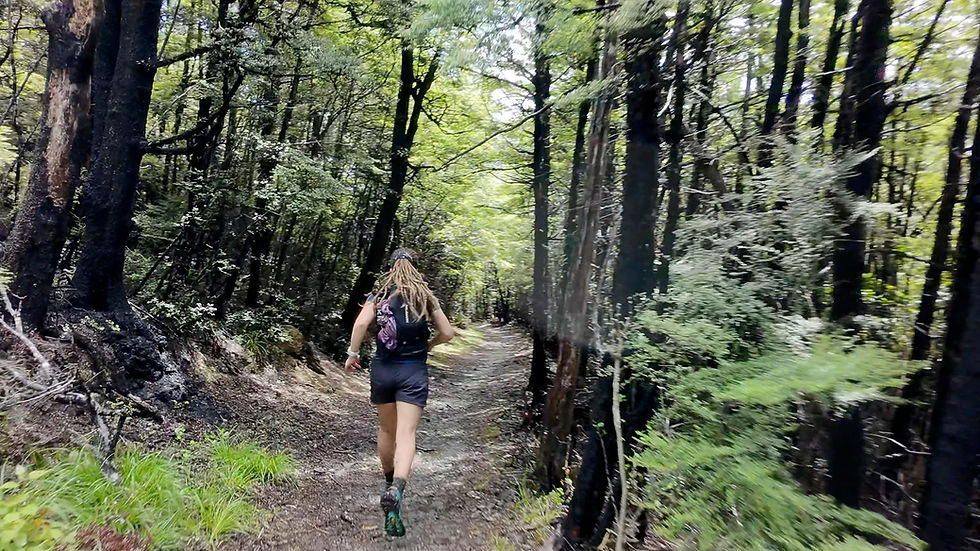
I knew where I wanted to be at each section of the course. Out of the forest around 18-20 minutes and onto the “Pebble Road of Doom” - a section that I had named the first year when it had fast become the most punishing part of the course for me - starting the Krayzie sand dunes by 30 minutes and across the boardwalk by 44 minutes. Then back into race village somewhere between 52 and 54 minutes.
A 54-minute loop doesn't leave much downtime, but in temperatures like these that actually worked in my favour. Standing around was colder than running. Each time I came in I would put my down jacket straight on which I was keeping warm by wrapping it around my hot water bottle in between loops. This ensured my temperature didn’t drop too much. An act that had not been necessary in previous years - but this year mother nature had bought different challenges.
By lap three my optimism about wearing shorts had completely disappeared.
My body was warm enough, but my legs had turned into two frozen tree trunks that were genuinely struggling to react to messages from my brain.
As I ran back into base at 10:25 my husband and daughter looked at me in horror, "Your legs are purple."
That was all the convincing I needed. Thermal tights went on and lo and behold, suddenly my legs remembered how to function.

From here, the loops started melting into one another.
Whistle blows.
Forest.
Pebble Road of Doom.
Sand dunes.
Boardwalk.
Race village.
Repeat.
There's something strangely comforting about the predictability of a backyard. Every hour follows the same pattern, yet every lap feels subtly different.
Around lunchtime, I could feel some hotspots on my toes which is often an area I struggle with, so I experimented with changing shoes. The pressure points disappeared almost instantly and my feet felt like they'd been given a holiday.
In a normal ultra you don't often get the luxury of swapping shoes, but in a backyard it's one of the easiest wins available. Highly recommend it.
The long afternoon
Eventually the sun made a proper appearance. The trouble was it was only warm if you happened to be standing directly underneath it. The rest of the course was still freezing. So every lap I seemed to alternate between sweating and removing a layer, only then finding that I needed to put it back on again five minutes later.

I knew that constant temperature regulation would be costing energy, so I stayed disciplined with my nutrition. One of my biggest process goals for the day was fuelling properly, and I was determined not to let that slip.
Before long the warmth disappeared again and it was once again about keeping layers on and trying not to leave my gloves on the snack table … oops - I only made that mistake once!
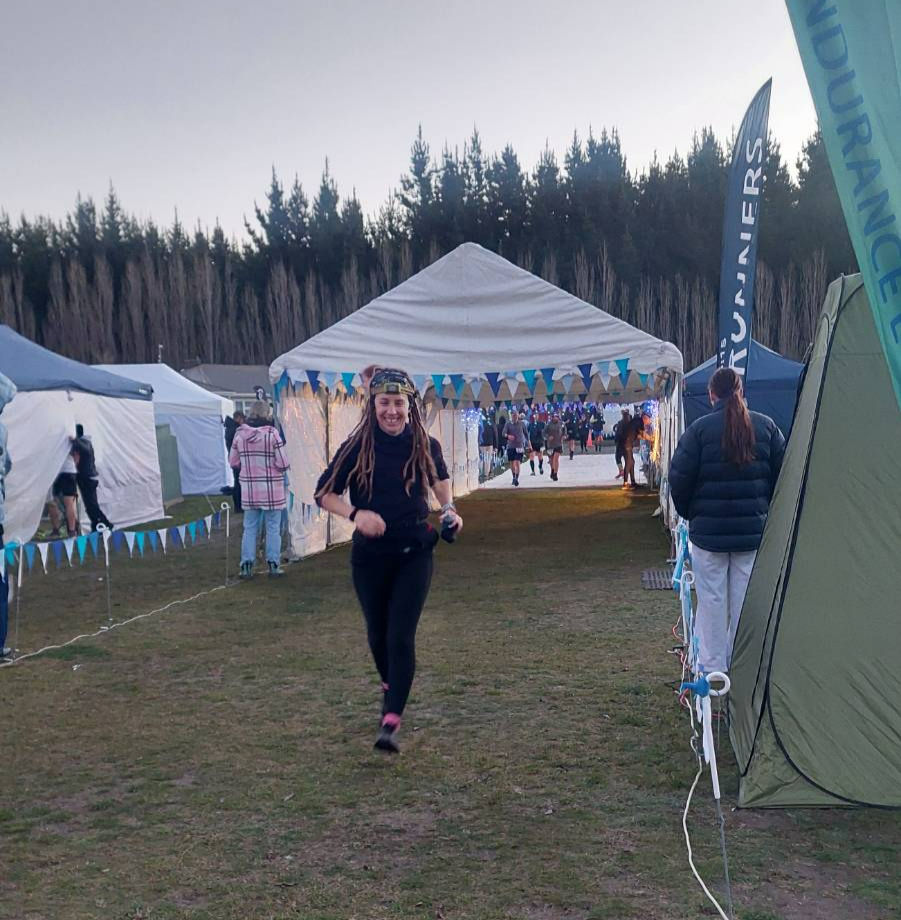
Before we knew it, it was time for the headtorches to make a reappearance for the 4:30pm lap. This was the point where, in previous backyards, I'd usually be well acquainted with the pain cave or/and battling nausea, but this year felt different. I was still comfortably ticking off 52-54 minute laps, still feeling good. My ankle had (unbelievably) stopped complaining, and I'd stayed on top of my nutrition and my feet were holding together remarkably well.

The only annoying thing that had plagued me ALL day? I needed to pee. Every. Single. Loop.
Soul destroyingly, at least one or two precious minutes disappeared into the campground toilets every hour. Gotta love a mother's bladder.
On the bright side, I knew I was well hydrated.
When the backyard starts fighting back
One of the things I love most about backyard ultras is the conversations.
You can spend almost an entire lap chatting to someone you've only just met. Everyone has their own story, their own reasons for being there, and somehow those conversations make the kilometres disappear. This was definitely my experience this time around and I met lots of people who I am really hoping I get to connect with again in the future.
As darkness settled in, chatter within the pack died down considerably, the dark demanded a little more concentration, but I enjoyed it. Trying not to break an ankle was, at least, keeping my mind occupied.
Somewhere around lap 11 things started getting interesting. I began getting stomach cramps which came and went intensely throughout the lap. My stomach definitely wasn't happy with me and I had to throw in a couple of faster laps so I'd have some extra "bathroom time" at the end of the loop. Running is a glamorous sport … said no-one ever, but hey, I didn’t end up sh!tting myself so I’ll take that as a win.
Most ultrarunners will experience some form of GI (gastrointestinal) drama eventually so we may as well talk about it. This was simply this day's version of it.
More importantly though, it became a problem to solve rather than the thing that ended my race and running those loops slightly quicker and reducing my caloric intake slightly in order to rest my gut was how I solved it and I went on to run my final laps almost entirely cramp free.
Throughout the day I'd set myself a series of process goals rather than outcome goals. Fuel well - tick. Look after my feet - tick. Stay emotionally steady - tick. Keep solving problems - tick. At this point I added another one; don’t sh!t yourself … tick!
Achieving those process goals felt just as satisfying as the distance itself.
Lap 15
I always knew lap 15 would be my last. Not because my body demanded it but because my own safety is more important than any race will ever be.
Living with epilepsy means looking after myself which sometimes means stopping while I still feel capable of continuing. Sleep deprivation simply isn't a risk worth taking. A seizure doesn't just mean a bad day—it can mean losing my licence, lasting cognitive effects, injuries, or worse, and that wasn't a fire I was willing to play with.
So lap 15 became less about racing and more about reflecting. I walked a little more than usual enjoying a slight release in pressure from the clock. I noticed how sore my feet were and how much I was looking forward to sitting down and not having to get back up to the sound of those blasted whistles again. I became very aware that I had a right knee - how long had that been sore for? And I realised how tired I was. I allowed myself to picture my warm bed at home, and couldn’t wait to be tucking myself into it soon.
With just over four minutes to spare, I crossed the finish line for the final time feeling relief, satisfaction and gratitude.
As I walked back into race village, I smiled. I'd stuck to the plan, looked after myself and still managed to cover 100 kilometres. That felt like a pretty good day's work.

Final thoughts
Even though this wasn't a backyard personal best for me, fifteen hours is still a long time to keep moving forward. One hundred kilometres is still a very long way and I’m well aware that no ultra is ever guaranteed. There is always time for things to go wrong no matter how experienced you are.
Every ultra reminds me of the version of myself who never believed any of this was possible. The Vicky, who thought ultramarathons were reserved for naturally talented runners. The Vicky, who had no idea how much adversity she would overcome just to stand on another start line. The Vicky who thought she simply wasn’t built for this sport.
And that's why I love the backyard format, it's a great leveller.
Nobody wins because they're the fastest. If anything, running too fast is usually punished. You find yourself sharing miles with people you'd never normally run beside, every runner chasing their own version of success.
Last weekend there were more than 200 stories unfolding around that 6.7-kilometre loop.
My story finished after 15 laps.
For others it ended after one.
And others, it continued long after I'd climbed into bed and into the next day and beyond.
Regardless of the distance, every story matters.
I'd encourage anyone to give the backyard format a go at least once. It may not end up being your thing. Honestly, I never thought I'd enjoy running the same 6.7km loop over and over either. Usually I'm happiest out in the mountains, chasing new views and exploring new trails, but there's something special about a backyard, something different.
Not many races give you the chance to truly find out what you're capable of and whether your limiting factor is your body or your mind. With a BYU you never know whether you've got one more lap in you until you're standing on the start line for it.
Add to that the conversations, the camaraderie, the problem-solving and the shared experience, and it becomes about so much more than just running in circles.
I came away with 100 kilometres under my belt, a few new friends, and another reminder that we're all capable of more than we think.
Thanks for following along for another adventure.
If reading this has you wondering whether you're capable of tackling your own trail race, backyard or ultra... the answer is, you probably are.
I genuinely believe running is for ordinary people willing to do extraordinary things consistently, not just naturally gifted athletes.
Helping runners discover that part of themselves is one of my favourite parts of coaching.
So if you've got a goal that's sitting in the "maybe one day" basket, I'd love to help you make it happen.
Feel free to flick me a message—I'd love to hear what you're training for.


Comments