
How to Fuel for Long Runs and Ultra Marathons: A Beginner's Guide


Why fuelling matters
Other than not wanting to look like I did in the above photo, the answer is actually pretty simple.
We need fuel to give us energy so we can keep moving forwards efficiently without feeling rubbish.
I like to think of our bodies like a mobile phone. Imagine you start the day with your phone fully charged. That 100% battery is only possible because you plugged it in overnight.
Our bodies work in much the same way. If we've eaten enough carbohydrate in the days leading into a long run or race, we start with our energy stores nice and full.
As you use your phone throughout the day, the battery slowly drops. The more you use it, the quicker it runs out. Eventually it reaches power-saving mode, where the phone starts switching off background functions to preserve what little battery it has left.
Our bodies do exactly the same thing. Instead of a battery, we store carbohydrate as glycogen in our muscles and liver. As we run, we gradually use up those glycogen stores and, if we don't replace them, eventually we hit our own version of power-saving mode.
Most runners have experienced this at some point. We usually call it "hitting the wall" or "bonking". Whatever you call it, it sucks and should be avoided at all costs.
Suddenly everything feels harder. You slow down, your legs feel heavy, your mood plummets, your brain becomes foggy, you make poor decisions, and nausea often comes to the party too. It isn't just your legs running out of energy—your brain is too.
That's why we don't wait until we're running low before we eat. We need to fuel proactively, not reactively.
For runs or races lasting longer than about two hours, we want to start fuelling from the very beginning. In fact, fuelling actually starts several days beforehand through carbohydrate loading, which simply means topping up those glycogen stores so you're standing on the start line with a fully charged battery.
Then, during your run, you're continually topping that battery back up so it never reaches empty—from the start line all the way through to the finish.
Why carbohydrates?
There are three main macronutrients: carbohydrate, fat and protein.
All three have important roles, but when we're running, carbohydrate is by far the easiest fuel for our bodies to use. It's quick to digest and convert into usable energy.

We can also use fat as fuel, and our bodies carry enormous fat stores, but turning fat into energy is a much slower process. That's why, when you're trying to keep moving over long periods, carbohydrate should become your best friend. Endurance runners are incredibly efficient at burning fat but regardless, you will still always be burning carbohydrates AND fat, just at different ratios dependent on the intensity, which is why we need to make sure we keep those carb stores topped up.
Protein and fat absolutely have a place during very long ultramarathons, especially events lasting many hours or even days. However, bear in mind that they take longer to digest and can increase the chance of stomach issues if you aren't used to eating them while running.
If you're just starting to practise race nutrition, I'd keep protein and fat fairly minimal and focus on getting your carbohydrates right first.
We can only store so much
One thing many runners don't realise is that our glycogen stores are actually quite limited.
How quickly we use them depends on lots of things:
How hard we're running
The terrain
The weather
Our overall fitness
How well we've fuelled beforehand
The harder the effort, the faster we burn through those stores.
Even on runs shorter than two hours, taking in some carbohydrate can improve performance and aid recovery. Once you're running beyond two hours, though, fuelling changes from being beneficial to being essential.
Your brain needs fuel too
One of the biggest misconceptions is that fuelling is only about your muscles. In reality, your brain relies heavily on glucose too.
Good fuelling doesn't just help your legs keep moving—it helps you think clearly, regulate your emotions and make sensible decisions when things start getting tough. Keeping your brain functioning well means you remain resilient and maintain your ability to problem-solve, which is one of the keys to endurance running.
When the going gets tough and DNF'ing starts to seem like a good idea, that can simply be a sign that you need more fuel.
If you've ever reached this point in a race—or find yourself there in the future—where everything feels hopeless, here's my advice:
Slow down or stop. Eat. Drink. Then keep moving (however slowly you need) for 30 minutes.
Do not make big decisions when you're running on an empty tank.
More often than not, once you've had some carbohydrate, some fluids and given your body a chance to absorb them, you'll feel like a completely different person. The hill doesn't seem quite so steep, the nausea settles, your mood lifts, and suddenly that finish line doesn't seem quite so impossible after all.
Side note regarding DNF’ing: Obviously, if you're injured or showing signs of heat illness or another medical emergency, stop and seek assistance as soon as possible.
My biggest nutrition lesson
One of my biggest (but not only) nutrition lessons came during my second ultra, Krayzie K's at Orton Bradley in Christchurch.
I had entered the 50 km event, which consisted of four loops of a figure-eight course, returning to a central aid station halfway through each loop and again at the end.
It was around 30°C, ridiculously humid, and I had very little understanding of hydration or nutrition back then. Doesn't sound much like a recipe for success, does it?
The reality was that I was planning to survive on hope, a prayer and a colossal amount of stubbornness.
It started well and I felt fantastic… until I didn't.
Around halfway, everything unravelled.
I felt nauseous, I could barely run, and my energy disappeared completely. I shuffled into the aid station in tears and was ready to pull out.
Thankfully, one of the amazing Krayzie K's crew members took one look at me and went into problem-solving mode.
They handed me an electrolyte drink with more carbohydrates than the one I'd been carrying and gave me an ice block.
Then they gave me a hug, a pep talk, another ice block and practically pushed me back out onto the course, refusing to let me quit.
Within a few kilometres, the extra carbohydrates started paying back the energy deficit I'd created, while the ice blocks cooled me down, helped hydrate me somewhat whilst also helping to combat the heat.
Those few simple interventions made a huge difference. I was still running on a major energy deficit, but it was better than nothing. My poor, under-fuelled body finally had something it could work with.
Gradually the energy returned, and the nausea took a back seat. Instead of being the loud, obnoxious guest taking over the whole party, it became the quiet introvert sitting in the corner. It was still there, but it was no longer running the show.
Relieved didn't even come close to how I was feeling, and I went on to finish that race feeling strong, having learnt two lessons I've never forgotten.
First, never underestimate how important carbohydrates and fluid are.
Second, never underestimate the body's ability to recover if you give it what it needs.

Practise in training, not on race day
Everything I've talked about so far applies just as much to training as it does to racing.
Fuelling your long training runs means you recover faster, reduce unnecessary fatigue and put yourself in a much better position to train consistently. Consistency is where the real improvements happen, and training your gut is where you learn what works for you.
Keep in mind that every runner's stomach is different. The only way you'll know what sits well, how much you can tolerate and what timing works best is by trialling different approaches and practising them. This will give you some reliable favourites—and hopefully a few backup options if things don't go to plan on race day.
By the time race day arrives, fuelling shouldn't be something you're making up as you go. It should be a well-rehearsed plan that feels almost automatic
.
You definitely shouldn't be trying anything new on race day.
Common fuelling mistakes runners make
I've made just about every mistake in this list at one time or another, and I've seen plenty of athletes make them too. Luckily, every one of these mistakes can be managed or mitigated with some educated experimentation and lots of practice.
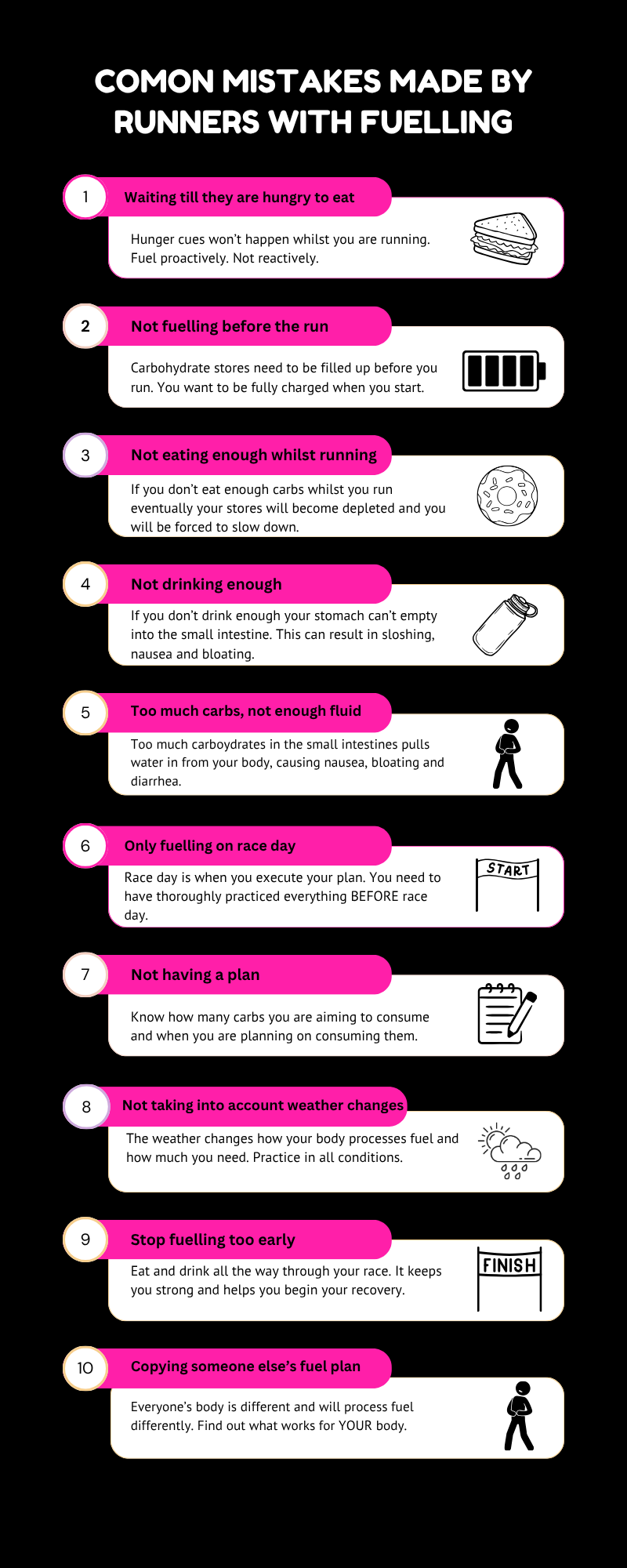
Waiting until you're hungry
One of the most common things I hear is, "I just don't get hungry when I'm running." Many people assume that this means their body isn't requiring food, but that's not the case.
When you run, blood is diverted away from your digestive system and towards your working muscles and your skin for cooling. Your body isn't thinking about food; it's thinking about keeping you moving and regulating your internal body temperature. It assumes that this is a short-term gig and that you'll be stopping soon and sitting down to eat like a civilised human being.
The problem is that we endurance runners are far from civilised and seem to think it's a great idea to run for many hours at a time… for fun.
By the time your body gets around to telling you it's hungry (if it ever does), you're often already heading towards glycogen depletion. You've started digging yourself into an energy hole and, unsurprisingly, you begin feeling flat and unwell. Unfortunately, once you feel like that, the last thing you want to do is eat or drink, so the problem only gets worse.
Which is why we need to fuel proactively rather than reactively.
Not fuelling before the run
Fuelling doesn't begin when you take your first gel during the race.
For long runs and races, your preparation starts the day before and, for your main goal races, it can even begin up to three days beforehand in the form of carbohydrate loading.
If we think back to the phone battery analogy, you want to make sure you're starting your run with a full battery, not one that's already sitting at 40%.
The moral of the story? Don't be scared of carbohydrates. They have an important role in helping you perform at your best.
Simply not eating enough
This is probably the biggest mistake I see.
Many runners have absolutely no idea how many grams of carbohydrate they're consuming each hour, often thinking they're eating far more than they actually are. It's an easy mistake to make, but it's equally easy to fix.
Start paying attention. Jot down what you've eaten and drunk at the end of each long run.
Work out how many grams of carbohydrate are in each gel, bar, drink or snack, then add them up and divide them by the number of hours you were out there.
You might be surprised by what it actually works out to and, over the course of a few weeks, you'll begin to build a much clearer picture of how many carbohydrates per hour you are already managing to tolerate. The answer doesn’t matter, as long as it’s honest and gives you a great base line to work from.
At the end of the day, if you don't know how much you're taking in, it's almost impossible to know whether you're fuelling well enough.
Not drinking enough
Food and fluid go hand in hand. Your stomach needs fluid to empty properly into the small intestine, where carbohydrate can be absorbed.
If you aren't drinking enough, that process slows down, meaning the fuel you've worked so hard to consume isn't getting where it needs to go as efficiently. This can lead to sloshing, bloating, stomach cramps and nausea—definitely not what you want whilst you're running.
Most people assume we only drink to replace sweat, but if we're eating, it's absolutely essential that we consume fluid to aid digestion as well.
Eating lots of carbohydrate but not enough fluid
Too many carbs can be just as problematic as not enough carbs. This can be caused by simply consuming more carbohydrate than our small intestine can absorb, or by not having enough fluid in the small intestine to dilute the carbohydrate concentration.
If the carbohydrate concentration in the gut becomes too high, your body responds by pulling precious water into the small intestine from the body to dilute said carbohydrate. This can also lead to stomach pain, bloating, cramping and diarrhoea.
Not only is that uncomfortable, but it also increases your risk of dehydration.
This is one of the reasons it's so important to practise how many carbs you can tolerate and to make sure you're drinking enough so your gut can process and absorb the carbohydrates you're consuming.
Thinking you only need to fuel on race day itself
It's amazing how many runners spend months training for an event, don't give fuel a thought, then try a brand-new gel, sports drink or energy bar, or tuck into whatever's available at the aid stations because they think that's just what you do.
This is not a good strategy and could result in a very unpleasant race day. It can also lead you to believe that a specific product caused you issues when actually it was just your gut not being used to digesting that concentration of carbs in one hit.
The reality is that most people can tolerate sports nutrition perfectly well; they just need to train their gut, exactly like they train their legs.
Your long training runs are where you experiment, make mistakes and figure out what works for you. Race day is the day you execute the plan you've already practised.
Not having a plan
If you don't know how much carbohydrate you're aiming for each hour, haven't tested what your body can tolerate and don't know what makes you feel good, how are you supposed to know whether you're on track?
A good fuelling plan removes decision-making when you're tired. It also helps prevent you reaching that point of tiredness in the first place.
The last thing you want is to be standing at an aid station wondering whether you should eat something. If you already know what works for you, you can eat and move on, confident that you won't feel rubbish 30 minutes later.
Keep reading and I'll show you how to build a simple fuelling plan that works for you.
Forgetting the environment changes everything
A nutrition plan that works perfectly on a cool spring morning may completely fall apart on a hot summer afternoon.
Heat usually means you'll need more fluid. Cold can make you forget to drink. Rain makes opening wrappers surprisingly difficult. Wind can make eating while running feel just too hard as you fight to keep hold of plastic bags and wrappers.
Challenging conditions often make us delay eating and drinking, which can turn an already hard day into an even harder one. Even something as simple as wearing gloves or using poles can make opening a gel packet frustrating.
The more conditions you can practise in during training, the fewer surprises you'll face on race day.
Stopping too early
One mistake that's easy to make is thinking, "I've only got ten minutes left. There's no point eating now."
But in reality, there's still benefit in fuelling right to the finish, whether it's a race or a training run.
Fuelling until the end reduces the energy deficit you finish with, kick-starts your recovery and leaves your body in a much better place for the next training session. This is especially important if you're training for an ultra and have another run planned the following day or later that week.
Copying someone else's plan
Just because your mate swears by 120 g of carbohydrate an hour doesn't mean that's where you should start. Elite athletes, influencers and your running buddy all have different levels of gut tolerance, body sizes, training histories and race goals.
Just like your running plan should reflect where you are based on your current fitness, so should your fuelling plan. It can then be gradually built and refined over time.
There isn't a magic number that works for everyone, and your ideal plan may end up looking very different from your friend's—and that's completely okay as long as it works for you.
If you feel consistently good and strong throughout a race, and you recover well afterwards, then your plan is probably working for you.
Simple strategies to start training your gut
The good news is that your gut is trainable.
Just like your heart, lungs and muscles adapt to training, so does your digestive system.
Over time, it becomes better at tolerating food while you're running, emptying your stomach more efficiently and absorbing more carbohydrate into your bloodstream.
So what exactly are we trying to train?
Getting comfortable with the feeling of having food and fluid in your stomach while you run.
Helping your stomach empty more efficiently into the small intestine.
Improving your gut's ability to absorb carbohydrate.
Like every other part of training, this doesn't happen overnight. Start small, be consistent and gradually build from there.
Start easy
If you're new to fuelling, begin practising during easy runs.
The harder you run, the more blood is diverted away from your digestive system and into your working muscles and skin for cooling. That means digestion slows down, making it much more likely you'll end up feeling bloated or nauseous.
Easy runs are the perfect place to experiment because the consequences of getting it wrong are much smaller, and less blood is diverted away from the gut because the workload on your muscles and your body's need for thermal regulation are generally lower.
Start with small amounts
When you're practising nutrition on your longer runs, aim for around 30 g of carbohydrate per hour to begin with.
Once that feels comfortable, gradually build towards 50–60 g per hour.
After you've mastered that, you can experiment with 80–90 g per hour if your race goals require it. Not everyone needs to consume that much, but gradually increasing your intake continues training your gut and gives you more flexibility on race day.
It works on the overload principle. If you can become comfortable consuming more carbohydrate than you need during training, then a lower carbohydrate intake on race day will feel much easier.
What does 30 g of carbohydrate actually look like?

Roughly speaking, 30 g of carbohydrate is about:
One energy gel (depending on the brand and packet size)
A large banana
Two slices of white bread
4½ Jet Plane lollies
180 - 200 g of boiled potatoes
You don't need to overcomplicate it. Start with one or two foods that you enjoy, then gradually build some variety into your plan.
Drink while you eat

Food and fluid work as a team.
If you're eating carbohydrates, make sure you're also drinking enough fluid to help your stomach empty and absorb those carbohydrates efficiently.
I personally like using an electrolyte drink that also contains a moderate amount of carbohydrate. It helps cover some of my hourly carbohydrate target while also replacing fluid and electrolytes.
As a starting point, many runners find around 300–500 ml per hour works well in cooler conditions, but your fluid needs will vary depending on your size, sweat rate, the temperature and your pace.
Finding out how much fluid you need can be tricky, especially since its so variable. First of all drink to thirst and secondly use urination as a guide. If you have not urinated in a few hours it's highly likely you are dehydrated and vice versa. Keep an eye on not only the frequency of urination but the colour too - the darker the colour the more you need to increase your fluid.
Whilst drinking may feel uncomfortable if you're not used to it, the more you practise running while drinking, the more efficient your stomach becomes at emptying into the small intestine, allowing carbohydrate to be absorbed into the bloodstream.
Don't be afraid of real food
Sports nutrition is convenient and can make hitting those carbohydrate targets much easier, but it isn't the only option.
Some runners love gels, some prefer liquid carbohydrates such as Tailwind, while others would rather stick to real food.
I am a firm believer that the best fuel is the fuel you'll actually eat, especially when you're tired, grumpy and five hours into a race.
Try both sports products and real food and find out what works for you. You may find that using a combination is the best way to hit your carbohydrate targets, and having a mixture of sweet, salty and savoury foods also helps prevent flavour fatigue.
Generally speaking, the longer your race, the more real foods you want to have in your arsenal.
Some ideas include:
Bananas
Mandarins
Sandwiches (jam, honey, peanut butter, Marmite or bacon)
Rice balls
Crumpets
Bagels
Roasted potatoes or kūmara
Mashed potato
Cheese toasties
Dried fruit
Crisps
Baby fruit purée pouches
Apple sauce
Practise the feeling of a full stomach
One of the easiest ways to train your gut is simply to stop running on an empty stomach all the time.
It's common to eat and then wait until your stomach no longer feels full before you head out for a run. That's completely fine if you're training for shorter, faster distances, but for longer endurance events, running with food already in your stomach can be a great way to train your gut.
You can start as simply as having a glass of carbohydrate drink before some of your shorter, easier runs, then gradually build up to eating small amounts just before you run.
When trying this, practise a few times on planned short, easy runs. If you've had gut issues previously, plan a route with toilet stops or run loops close to home so you can dash back if needed. This helps build both tolerance and confidence.
It will feel a little strange at first, but over time your body adapts. That full feeling becomes much less noticeable and wears off more quickly as your stomach becomes more efficient at emptying.
Practise often
You don't need to save nutrition practice for long runs only.
Any run lasting longer than about an hour is an opportunity to practise eating and drinking while you're moving and even your short runs can be used for practice at running with food in the stomach. Just because you can complete a run without food or fluid doesn't mean it's beneficial. The more often you practise, the more automatic it becomes.
My simple long-run strategy
Everyone's plan will look a little different, but this is the basic strategy I use for most of my long runs, right up to distances that take around 12 hours.
A small carbohydrate-rich snack (usually a sandwich of some form) about an hour before I start.
One gel around 10 minutes before the start.
One gel approximately 30 minutes into the run, then roughly every hour after that.
Small amounts of real food between gels.
Around 300–500 ml of an electrolyte drink per hour in cool temperatures that has a moderate level of carb concentration, which provides me with an additional 20–25 g of carbohydrate. I'll increase that fluid intake significantly in warmer conditions, using a mixture of water and electrolytes.
I also love Coke and know that I can digest it easily, so during races I always look forward to aid stations that have it available.

Is it a perfect strategy? Probably not.
But it works well for me because I've spent years testing, tweaking and refining it.
I'm still working on it—still building my own gut tolerance.
I also have to be intentional about it because I notoriously get lazy with "running admin", as I get lost in the beauty of the trail and the flow state of my run.
But I know my strengths and weaknesses, so it's something I work on constantly. I know why I need to do it—I just still have to make myself do it.
I don't share my strategy so you can copy and paste it (remember the section on common mistakes!). I share it because it's an example of how simple a nutrition strategy can be and, hopefully, it gives you a framework to experiment with and make your own.
Don't forget the logistics
As well as working on what your gut can tolerate, rehearse what it actually looks like to eat and drink while you're running.
Some gel packets can be a nightmare to open and you end up covered in sticky goo—which I personally find super annoying. For long races, where I know I'll be consuming multiple gels, I either decant three or four into small soft flasks or use gels that come in baby-pouch-style packaging. Much easier!
Use your running vest in training so you know where and how you'll store your food. Can you access it easily without taking your pack off? This is essential. If you have to remove your pack every time you want to eat, you probably won't eat enough, especially once you get tired as the race progresses.
Can you chew your food while you're running? It's all well and good taking your favourite popcorn, crisps, lollies or marshmallows onto the trail with you, but if they're difficult to chew and you end up fighting for your life, gasping for breath while trying to swallow them, you're going to struggle to get enough in.
Can you keep your food dry if the weather turns bad? Soggy sandwiches wouldn't be particularly appealing (vomit reaction!).
The final piece of advice
The best fuelling strategy is the one you can actually stick to.
It doesn't matter how scientifically perfect your plan looks on paper, if you hate eating the food, can't open the wrappers with cold hands, or discover halfway through a race that your favourite snack is impossible to chew while climbing a hill.
Test everything.
Practise in the conditions you'll race in - even the ones that aren’t as likely.
And remember, your fuelling plan is just like your training plan—it should be practised, refined and personalised until it works for you.
Ready to stop guessing?
If you're tired of wondering whether you're eating enough, drinking enough or doing the right things in training, coaching can take all of that guesswork away and give you a sounding board as you go through this trial and error process.
Together we'll build a training plan, a fuelling strategy and race-day systems that are tailored specifically to you—so you can spend less time worrying and more time enjoying your running.
If that sounds like something you'd like help with, I'd love to hear from you.
Please note the advice in this article is intended as general education for healthy runners. If you have a medical condition such as diabetes, coeliac disease, inflammatory bowel disease, food allergies or other nutritional concerns, speak with an Accredited Practising Dietitian, Registered Dietitian or your healthcare professional before making significant changes to your nutrition strategy.

Comments