
Trail Running Training Explained: Why using Pace Doesn’t Work for Ultra Runners

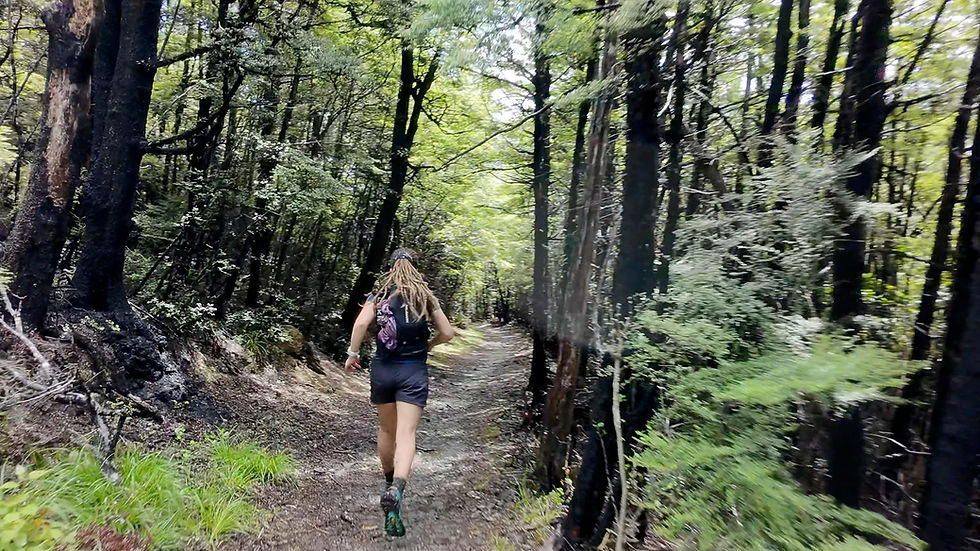
When it comes to trail running, the way we approach training needs to be done differently compared to how we approach road running. Trail running is not linear and our training tactics need to be as flexible as the trail conditions.
The terrain of trails is constantly changing, sometimes you’re climbing, sometimes descending, sometimes picking your way through something technical. All of which affects how fast you can move and how much impact/load is placed on the body. Even the weather plays a role and because of that, pace and distance quickly becomes an unreliable guide.
What matters more is how much stress you’re putting on your body, and that doesn’t come from distance alone. Time on your feet plays a huge role too and managing how much time we have on our feet helps us to manage the overall load and avoid injury.
For example, a 10 kilometre run on the road might take an hour. That same distance on the trail could take twice that, and include elevation and technical terrain too, which significantly increases the load on your body. If you try to match your road-based distance targets out on the trail, you either run out of time in your week, or you push your body into a level of fatigue that significantly increases injury risk.
Let’s also not forget why you are out there in the first place. For most trail runners it’s not about speed and distance, it’s about the adventure and experience that the trails offer. The mental space, the challenge, and the connection to nature are all really important.

Constantly checking your watch is not only dangerous on technical trails but it pulls us away from the enjoyment of the activity we have chosen to engage in. And since we are choosing to put so much of our soul, time and effort into training we need to be able to enjoy the journey too.
So if not using pace then how do we measure and make sure we are moving forward towards achieving our goals? We learn how to run by feel.
That doesn’t mean training becomes vague or unstructured. It just means we shift the way we measure effort.
Rather than using pace, we use Rate of Perceived Effort, or RPE. It’s a simple scale from 1 to 10, where 1 is complete rest and 10 is a full, all-out effort. From there, we can define different types of runs based on how they should feel, rather than how fast you’re moving and this means we can change our pace according to the gradient or trail conditions in front of us. On a climb, you’ll slow down, but the effort remains consistent and that will still stimulate the body to make the physiological adaptations that make us fitter and faster.
The RPE scale allows me to prescribe a combination of 5 run effort levels, (of which multiple could appear in any one run to indicate a change of pace). These are:
Easy/Recovery run
Endurance
Steady state
Tempo
Intervals

Easy or recovery runs sit around an RPE of 4 to 5. You should be able to hold a full conversation, and tell a story. These runs keep your overall volume up without adding too much stress, and they’re incredibly important for ultra runners, because this is often the kind of effort you’ll come back to on race day, the longer the run the more this pace will be used.
Endurance runs sit slightly higher, around RPE 5 to 6. Still comfortable, still sustainable for a long time, but with a little more intent. Your conversation might be a bit more broken up, but it’s still there.
Steady state runs moves into a more challenging space at around an RPE 7. Your breathing becomes deeper, more laboured, and conversation shortens to a couple of sentences at a time. This is where you start building your higher-end aerobic capacity.
Tempo effort runs push that further again, sitting around 8 to 9. Breathing is quicker, more intense, and holding that effort becomes much more difficult. These runs help your body process and reuse lactate more efficiently.
Interval runs are your hardest efforts at an RPE of 10. These are short and hard and you’re working at your limit. There’s no conversation here—just getting through the effort. You may be able to offer one word expletives occasionally but that’s as articulate as your conversations will be able to get.
Across all of these, the goal is to keep the effort consistent, not the pace. That takes practice, but over time you start to tune into your body in a way that a watch can’t teach you. And as that happens, you’ll notice your pace improves naturally at the same effort level.
So how does time factor into the training plan?
When training for an ultra, distance can be substituted for time. It’s a far more useful metric than distance when taking into account training for an ultra race. It allows you to account for all the variability that comes with trail running and gives you a much clearer picture of the load you’re placing on your body across the week.
For instance, fifty kilometres on the road might take 5 hours. On the trail, that same distance could take 8-10 hours, or even more. Add elevation into the mix, and the physical demand increases again. If you only focus on distance, it’s very easy to unintentionally overload yourself.
But when you train based on time, you can build that load gradually and sustainably. It becomes much easier to manage cumulative load, reduce injury risk, and stay consistent over the long term.
Conclusion
Importantly, when using time and RPE to create a training plan, it doesn’t mean that all training needs to be done on the trails. Most people don’t have the luxury of doing 100% of their training on trails but the same concept of time and RPE can be used when running on the roads in order to complete the bigger picture of what each week’s training load looks like.
Of course, your watch is still collecting data like pace, distance, elevation gain and heart rate. These can absolutely still be used alongside RPE, but rather than dictating your training, they become tools to observe trends, track progress, and make informed adjustments over time.
Ultimately, this is why I build training around time and effort. It allows runners to train consistently, adapt to real-world conditions, and develop the awareness they’ll rely on when it matters most.
Over time, it also builds confidence in yourself, one that doesn’t come from hitting numbers on a watch, but from understanding your body and trusting how it responds. In any trail running event, success comes from managing your effort over a period of time with constantly changing variables, and you will already be well attuned on how to adjust according to whatever race day throws at you.
If you’re training for a trail running event and want a plan that actually fits your life, your trails, and your goals, feel free to reach out. I’m always happy to chat.


Comments